Is it Possible to Foresee the Treatment Outcome? Disease and Treatment Predictions with Artificial Intelligence in Dentistry
General
14 Aug 2026
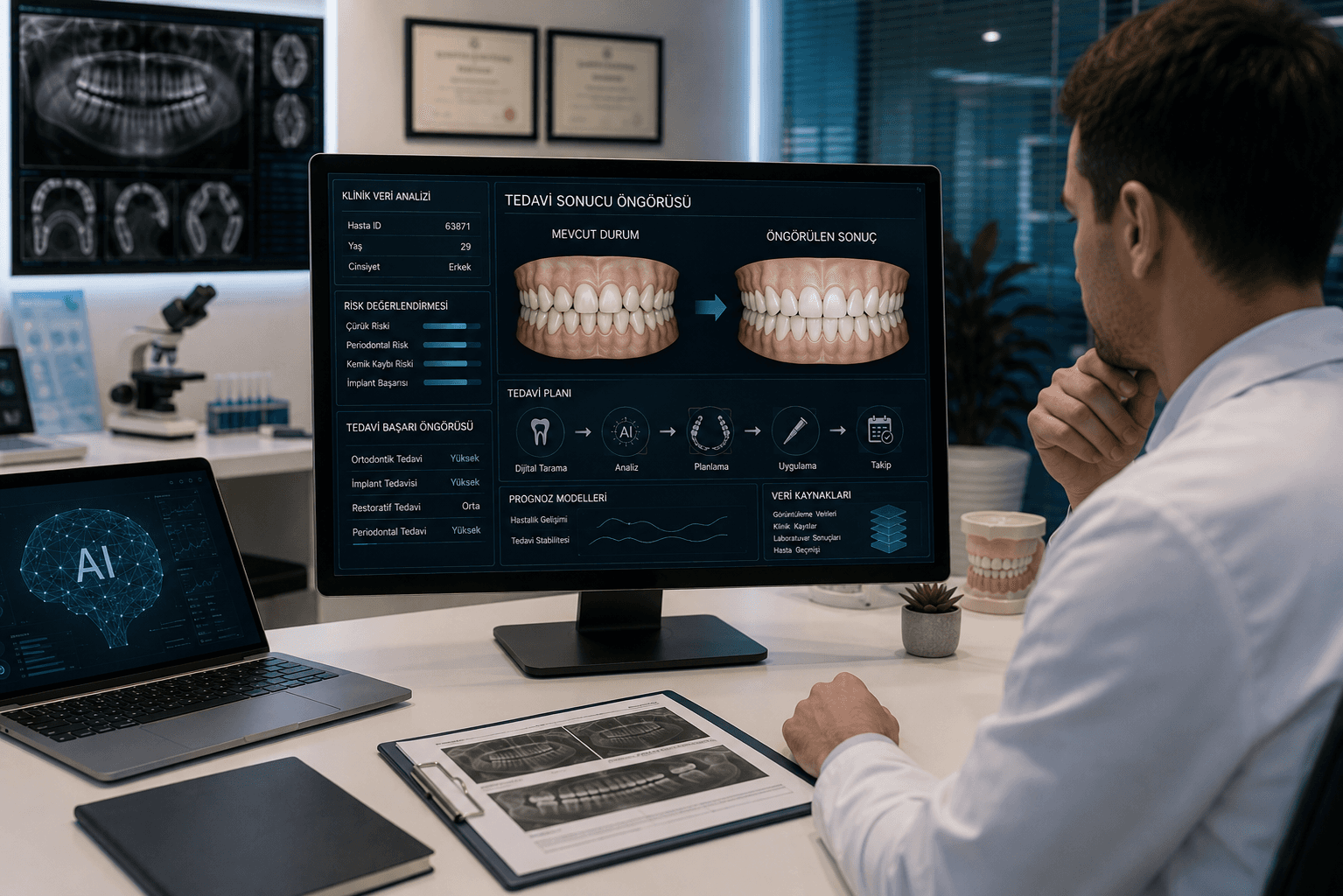
In addition to analysing images in dentistry, artificial intelligence also opens up new fields of study in terms of generating predictions regarding disease progression and treatment processes based on clinical data. BAU Dental Campus positions treatment success and disease progression predictions through machine learning directly among its study topics in its technology-centered research ecosystem. Deep learning, machine learning and neural network models are utilised within this structure, which extends from the analysis of clinical data to treatment planning.
Clinical data analysis, imaging technologies, treatment planning and prognostic models are featured together in the artificial intelligence and technology infrastructure officially announced by BAU Dental Campus. Machine learning models, on the other hand, are handled within the scope of studies aimed at predicting treatment success and disease progression. These topics show that artificial intelligence is examined in different stages of diagnosis, assessment and treatment planning processes in dental research.
Another topic in BAU Dental Campus's artificial intelligence infrastructure is AI-based clinical decision support systems and personalised treatment planning. On the official website, these technologies are shown among the usage headings of artificial intelligence applications in the field of dentistry. The inclusion of clinical decision support, treatment planning and machine learning-based prediction models in the same technology ecosystem allows different artificial intelligence applications to be researched together in dental sciences.
In addition to this technological approach, the clinical infrastructure within BAU Dental Campus includes digital patient tracking systems and X-ray, panoramic and 3D imaging technologies. The official website also states that the clinics enable physicians and students to develop research projects, and offer academic clinical observation and case analysis opportunities. This structure creates a working environment where education, clinical practice and research activities can be carried out within the same campus.
AI-supported prediction studies are not positioned as a technology topic handled on its own at BAU Dental Campus either. CNN-based imaging models, AI-supported clinical decision mechanisms, personalised treatment planning and AI-integrated CAD/CAM systems are among the officially announced technology areas. Thus, different artificial intelligence applications, from image analysis to digital workflows, are treated as parts of the same research and technology approach.
Artificial intelligence research in dentistry focuses on how data regarding the progression of diseases and treatment outcomes can be analysed, as well as the assessment of current clinical conditions. BAU Dental Campus's inclusion of treatment success and disease progression predictions with machine learning among its study areas constitutes one of the topics examining the role these technologies can play in future dental research. Here, artificial intelligence is positioned within a body of technologies developed to support clinical and scientific assessments, rather than as an independent decision mechanism.